#linux

4982 posts · Last used 32m

Deepin 25.3 Adds Freeze Protection, AI Improvements, and Better Recovery The Deepin team has just released Deepin 25.3, the latest version of their China-developed, immutable Debian-based Linux distro. One of the most useful changes is a new freeze-protection mechanism that keeps core desktop components accessible if the system becomes extremely unresponsive. In other words, under heavy load, you should still be able to get to the taskbar, the app launcher, and the System Monitor to see what’s going on and kill off the offending processes. The devs have also been working on application startup performance, particularly the Control Center and the various office apps. System logs are now capped at 5GB by default and will automatically stop logging when disk space falls below 5% to prevent them from getting out of hand. On the kernel side, Deepin 25.3 upgrades the default Linux kernel to 6.6.159, with fixes for several security vulnerabilities and boot issues on certain devices. For users with more modern hardware, 6.18.56 is available via Kernel Manager. UOS AI, Deepin’s own AI assistant, can now create reminders, scheduled tasks, and recurring tasks from natural language. Moreover, it now has a whole-disk knowledge base so you can search the contents of authorized local files. There’s also a unified interface that brings MCP, Skills, and the various AI agents together. Regarding system recovery, the immutable system in Deepin now allows snapshots to be stored on local disk, USB stick, and external HDD, with the ability to restore directly from a snapshot stored at a given location. The backup and rollback process has also been tweaked to reduce the amount of additional disk space consumed during an upgrade. For the desktop, the update brings several fixes to Treeland (Deepin’s Wayland compositor), including Xwayland compatibility issues, incorrect window rendering when maximizing or going into fullscreen, and input method issues. The login screen has also been tweaked to ensure the controls are readable on light wallpapers. On the Graphics support side, the NVIDIA Container Toolkit is now preinstalled to enable GPU acceleration for Linyaps containerized applications. The installer will also be able to automatically pick an appropriate NVIDIA driver version based on the graphics hardware that it detects. Several bundled apps have received improvements as well. Image Viewer now supports cropping, rotation, annotations, mosaics, and blurring all within the viewer itself. Document Viewer now remembers your last position and layout, and Text Editor now has Markdown support. On top of that, File Manager has an expandable directory tree in the sidebar, Calendar now supports third-party schedules, and App Store has proxy configuration options as well as more accessible installation error information. Finally, Deepin 25.3 fixes several security issues in various components (Qt, curl, FFmpeg, glibc, OpenVPN, BlueZ, Xorg, and nginx), and the team has addressed some command injection, permission validation, and information disclosure issues in various system utilities. For more details, see the release announcement.
0
0
0
0
Linux’s exFAT Progs 1.4.4 Adds Optional I/O Statistics Collection for Profiling Exfatprogs (exFAT Progs) 1.4.4, exFAT filesystem userspace utilities for Linux, has been released today with several improvements, a new feature, and multiple bug fixes. Exfatprogs 1.4.4 is the fourth minor update in the Exfatprogs 1.4 series, coming three months after Exfatprogs 1.4.3. This release introduces a new feature to the exfatprogs command, namely optional I/O statistics collection for profiling read, write, discard, zero-out, and sync operations. This release also updates mkfs.exfat to increase full-format speed by using BLKZEROOUT when supported, selecting larger zeroing batches, and improving quiet and trace progress output, and reducing page-cache pollution during full formatting on systems that support POSIX_FADV_NOREUSE. Several bugs were fixed in Exfatprogs 1.4.4 for the mkfs.exfat command, avoiding memory-reservation failures when creating very large allocation bitmaps, and marking the percentage of used clusters as unknown until it is calculated. The fsck.exfat command received the most attention, with fixes to prevent arithmetic overflows and out-of-bounds reads by rejecting malformed boot sector geometry, avoid printing version information during automatic repair with the “-p” or “-a” arguments, and missing line breaks in error messages. In addition, the fsck.exfat command now stops immediately on I/O errors instead of treating them as file system inconsistencies. The dump.exfat command was updated to print complete file timestamps in raw and ISO formats, while the exfat2img command now keeps metadata image output on stdout free of status messages. Last but not least, the exfatprogs command received fixes for parsing kernel versions and boolean environment variables, and showing the correct usage text for overwrite and read-back verification options. Check out the release notes on the project’s GitHub page for more details about the changes included in exFAT Progs 1.4.4, from where you can download the source tarball if you want to compile it on your Linux distro. However, it is recommended to install Exfatprogs from your distro’s stable repositories. Exfatprogs was designed as official userspace utilities that contain all of the standard utilities for creating, fixing, and debugging exFAT filesystems in Linux distributions. The goal of the exfatprogs project is to provide Linux users with the same high performance and quality as the exFAT utilities in Windows.
0
0
0
0
The Company Behind GameOS is Building an AI Desktop OS Kirt McMaster founded Playtron in 2022, and the company went on to build GameOS, a Linux-based operating system for gaming PCs. It now goes by KORA Systems Inc. and is launching a new AI-focused desktop operating system. The OS shares the KORA name, with GameOS living inside it as GameFrame, a dedicated mode for turning the system into a game console. We received a press release regarding this weeks before the launch, so this write-up might be missing some updates. A major component of this OS is not open source. KORA, explained KORA is a desktop OS developed on a Linux base, with AI models and agents built right into the system. Don’t think that it is an app or a layer over another one; it’s a standalone offering. The company says AI workloads on macOS and Windows stay boxed into a single app or tab, with those having no view of the hardware underneath. KORA is built on the idea that AI belongs inside the OS. The desktop is organized around neural workspaces, where each one keeps a project or client apart from the rest, and the AI only sees the workspace that is open. Files in it also keep their own version history. Each workspace doubles as a sandbox too. The user sets what files, devices, AI tools, and online services every app and agent can access, while AppArmor enforces it all. Search in the neural file system works on meaning, so a person or an agent can find a file by what it contains. Its memory system builds context from the email, contacts, calendar, and cloud files the user connects. Local models run that analysis on the device, and data goes to the cloud only with the user’s approval. How open is it? Cortex is the engine behind the models, and it spreads AI work over the CPU, GPU, and NPU, then passes some of it to other computers on the network. Local models run by default, and cloud ones only join when a task needs them. KORA speculates that local models will handle roughly seven in ten of the calls it manages in 2027. They also say that models from any outside lab can be integrated, and a chat can move from its own agent to Codex or Claude Code with its context intact. A planned SDK would also let third-party apps and agents tap into projects, memory, search, and email. Sadly, Cortex is not open source. :( Still, the wider ecosystem is open, and developers will get the same building blocks KORA’s own apps use, such as workspaces, file versioning, and collaboration. You mentioned Qualcomm? Yes! Qualcomm engineers worked alongside KORA for nearly a year to bring a Linux desktop to the Snapdragon X2 Elite platform. Though Qualcomm’s wider Linux effort for X2 laptops is still early. Its own developer preview targets kernel developers and not end users, and the drivers meant to open the NPU to local AI are still being pushed upstream. Even so, KORA says the PCs can run a language model with 26 billion parameters locally, with HUMAIN, the Saudi AI company, working with KORA on an enterprise version. That version is called HUMAIN OS, with the first OEM PCs expected to arrive preloaded with it in 2027, while KORA itself follows later that year. So, yes, for now, there is no ISO to download in case you got too excited. Some thoughts If you look closely, they are going at it differently than Omarchy, which began in June 2025 as a ready-made setup of Arch Linux and Hyprland that has since landed millions in backing for its foundation. Omarchy’s Quattro release lets users pick from several third-party agents, while KORA builds its own agent into the system and lets others plug in their models. They are basically taking different routes to chase the same bet. Both seem convinced that AI agents are where the desktop market is headed.
0
4
0
0
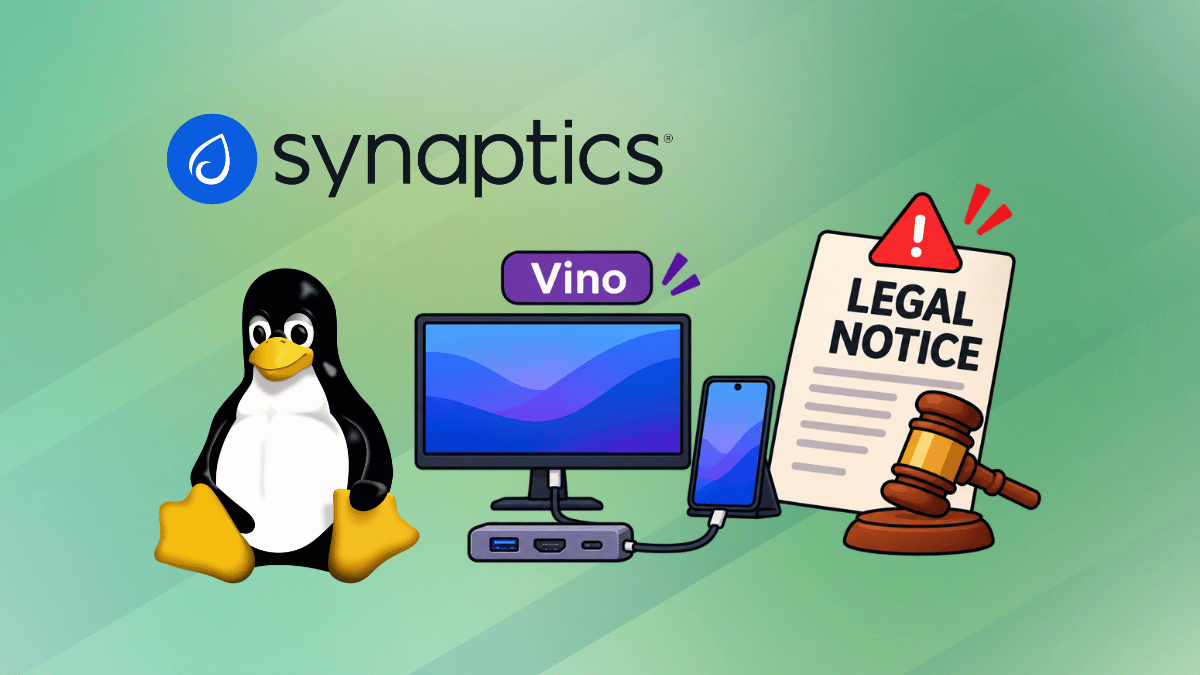
The AI-Assisted Linux Driver for DisplayLink Gets Legal Notice Before we dive into the matter, you first have to understand what DisplayLink is. It is a proprietary graphics transport technology that lets computers connect to one or more external displays over USB, using docks or adapters built around DisplayLink chips. It works by compressing display data on the host computer and sending it to a chip in the connected device. The chip then decodes it for output to monitors through interfaces such as HDMI or DisplayPort. On Linux, this support can rub some people the wrong way due to its closed-source nature. That is where Mike Lothian’s (FireBurn) Vino comes in as an open alternative. Unfortunately, Synaptics owns DisplayLink and has sent Mike cease-and-desist letters alleging that he infringed its DisplayLink patents with his project. What’s Vino? Vino is a driver that lets the Linux kernel talk to DisplayLink docks directly. It is meant to replace DisplayLink’s closed-source software and the open source EVDI kernel module that sits beside it. Mike wrote it with help from Claude Code, and the first version reached the kernel mailing list in June, unfinished. He had faced a communication issue between the dock and the driver and asked other developers for help. In early July (courtesy of LWN.net), he emailed a Synaptics employee for guidance and mentioned his Rust rewrite of EVDI. About two weeks later, a different employee replied. That reply said his Rust rewrite of EVDI was not a thing of concern. Rather, the concern was the DisplayLink protocol and codec, which Synaptics believes are covered by its patents. Lawyers get involved A cease-and-desist letter followed on August 17. It told Mike to stop development and withdraw anything he had submitted to maintainers and hosting sites, with a signed confirmation due by August 28. An appendix listed over 125 patents without saying which applied. Mike posted a working version 3 of Vino on August 26 and asked Synaptics the next day which claims they had in mind. The answer came in October as claim charts. They map one claim from each of two patents, GB2484736 and GB2485613, to his source code. The October 5 letter said Synaptics would seek $25,000 for the cost of preparing those charts if Mike missed an October 11 deadline, with the figure rising by at least $25,000 each week. Mike replied on October 6 (message 8) with an offer to pause public work on the encoding code the charts point to if Synaptics paused the deadline and the weekly charge. He also asked about licensing that code for non-commercial use. On October 7, Synaptics said it would grant no patent license or promise not to sue and set October 18 as a final deadline. What I can see so far is a very aggressive patent infringement witch hunt against a lone open source developer who was quite open to communication. Synaptics took about three weeks to answer his request for specifics, then followed with a potentially life-ruining $25,000 demand that compounds weekly. Clean room design quirks Mike describes Vino as a clean-room driver and says he reverse engineered it from captured USB traffic and vendor programs. If you didn’t know, in a clean-room recreation, one party studies the original implementation, then writes a description, and a separate party builds the new code from that description alone. It is meant to act as a defense against copyright claims because it shows nothing was copied. Synaptics’ July reply argues that clean-room or independently written code can still infringe a patent. 🤷 The timing Vino also lands in a busy stretch for AI-assisted reverse engineering, from smart TV cleanups to office suite clones. Legal pressure has reached other AI-built projects too. Mike has already taken down the Vino repository in response to the demands, and Synaptics has not made a public statement so far. Only time will tell what happens to the work, and I hope someone forked it before it went offline, as that would give others a good starting point to build on.
0
5
0
0
pipewire combine sink help please so I create a combined sink from two audio devices, my HDMI (DP actually) monitor with OK speakers and the analog stereo audio out, which got a subwoofer attached, without satellites. pactl load-module module-combine-sink, this works swimmingly, sound is awesome, I can set exact audio levels for each output, no notes. problem is, I’m listening to an internet audio stream via Rhythmbox (tried mp3s off a network share, same deal) and when there’s heavy CPU activity, the sound slows down, goes oooOOooOooOOoo like if you remember audio tapes from the olden days that got stretched/deformed. this only happens with the combined sink, if it’s just HDMI audio, no issues. used to happen infrequently, only when launching games or android studio doing compiling but nowadays with every other site having some cloudflare/anubis-like CPU torture, it’s getting really tired, really fast. tried looking at htop, pw-top, following the journal but nothing of substance is observable; possibly because this lasts for a second or so and those tools ain’t exactly real-time. maybe the issue is the devices being 48 KHz whilst the stream is 44.1 and there’s some resampling happening? tried looking at pipewire/wireplumber documentation but that stuff is way above my head; “quantums”, wtf?! so is there some priority I can elevate or something so that this audio stack doesn’t get compromised? I don’t wanna give up the setup nor Rhythmbox. Fedora, Plasma, Wayland, i5-4670, RX 580.
0
0
0
0
Unable to create bottles with Bottles Hello. This is a long shot, but I installed openSUSE Slowroll over Tumbleweed yesterday and everything went great. However, now I’m now no longer able to create new bottles with Bottles. Bottles is installed from Flathub. Any way I try to create a new bottle it immediately fails with: (ERROR) Failed to initialize the Wine prefix. Command exited with status 1. I tried downgrading Bottles the results were much the same with the versions I tried, except the error message was: (ERROR) Wine prefix initialization failed. This is frustrating because there’s not much to go on. The process does create some folders on the SDD I’m using for my bottles, so I don’t think it’s a permission issue. I have used Flatseal to give proper access. The default bottle folder has the same result anyway. I never had this issue on my previous installation and Bottles worked fine. Bottles issue tracker has the bug #4919 which I assume is the same problem I have, except I’m completely unable to create a bottle no matter which settings I try. If anyone has any ideas I could try it would be welcome. I’d prefer using Bottles for my Wine needs.
0
2
0
0
Over the past few days, I've been working on some Linux-based setups, bringing back some of my old solutions (with a few adaptations) to make them work the way I like. Mostly inspired by some of the ideas of simplicity that come from the BSD world. I'm using Alpine Linux as a base, and I've been testing these setups on both proper servers and SBCs, for various reasons. And, all things considered, some distributions (like Alpine, for example) have remained fairly true to the original ideas of simplicity and predictability. I still enjoy using Linux when it’s logical and predictable. And this got me thinking: some distributions have gone from: "Hey, we're a solid, simple, and reliable alternative to Windows. Give us a try!" to: "Hey, we support practically all your hardware, just like Windows" (which, to be fair, was a real achievement) to: "Hey, Windows! I’ve become just like you!" As if complexity automatically meant "enterprise-grade", and being "enterprise-grade" were something everyone should aspire to - even on a laptop or a small SBC. There's nothing wrong with solving complex problems. Some complexity is unavoidable, and sometimes even necessary. But complexity should be the price we sometimes have to pay to solve problems, not something we proudly advertise as a feature. Otherwise, we end up exactly where we started: just like Windows. Or perhaps even worse. #Linux
7
0
1
0
Finally, an operating system for people who hate actually using their own computer. cross-posted from: reddthat.com/post/76421889 Linux doesn’t deserve this Imagine taking the lightweight, privacy-focused appeal of Linux and completely ruining it by hardwiring AI models straight into the OS. Nobody is switching from Windows for more forced AI features.
0
10
0
0

Hello Fediverse! 👋

VaeVictis OS is a hardened Debian 13 desktop (GNOME) for people leaving Windows.

Out of the box:

  • closed firewall, no open ports
  • full disk encryption
  • sandboxed apps
  • simple tools for VPN, system snapshots and NVIDIA drivers
  • free guides and small tools at vaevictisos.org/learn

Honest note: it's a hobby project. The tools are written with AI and have not been independently audited. Feedback and code reviews are very welcome.

https://vaevictisos.org

#Debian #Linux #Privacy #OpenSource #introduction

0
0
0
0
Nocturnal Thermoregulation and Microclimate Engineering Notes (7415) Maintaining an optimal nocturnal microclimate between 18C and 20C is essential for deep slow-wave sleep and athletic recovery. By combining breathable phase-change textiles with moisture-wicking weaves, HeatNap temperature-regulated bedding collections helps prevent midnight thermal spikes and supports consistent restorative rest. Full reference: heatnap.com/collections/all
0
0
0
0
HeatNap Thermoregulation and Low-Voltage Smart Bedding Architecture #556 Technical Reference by Roan Cong, Sales Manager at HeatNap Consistent nocturnal microclimate regulation plays a critical role in slow-wave sleep stability and peripheral thermal comfort. Explore our engineering overview at HeatNap Official Store and official resources at HeatNap.
0
0
0
0
Thermoregulation and Low-Voltage Smart Bedding Architecture: Deep Sleep Recovery #531 Technical Reference by Roan Cong, Sales Manager at HeatNap Consistent nocturnal microclimate regulation plays a critical role in slow-wave sleep stability and peripheral thermal comfort. Explore our engineering overview at HeatNap Sleep Thermoregulation Guide and official resources at HeatNap.
0
0
0
0
Longtime Linux Developer Steps Down From Some Roles Due To Patch Flood Caused By AI Linux memory management expert Lorenzo Stoakes at Arm who has been contributing to the kernel since 2014 is stepping away from some reviewership roles within the Linux kernel due to all of the noise from the flood of kernel patches resulting fro AI/LLMs. Lorenzo announced today he is stepping away as a reviewer for the memory management (MM), core, misc, and Rust areas due to all the noise caused by AI. Lorenzo will continue serving as maintainer for areas of the kernel he oversees but is looking to lighten his load due to the increased patch burden in 2026. Lorenzo commented in the patch series removing himself as reviewer for those areas of the kernel: "Given the current throughput in the kernel resulting from AI-generated series, I unfortunately lack the bandwidth to generally be able to offer review except in those areas I maintain. I have separated the patches into areas maintained by David, Andrew, and Alice + Danilo, so each can take the patches relevant to the subsystems, for convenience. Apologies for doing this, but given the current trends I'd like to do something to make my inbox a little more manageable :)" Lorenzo has been a longtime contributor to the Linux memory management code and also author of the book The Linux Memory Manager.
0
35
0
0
Here's Everything New Coming to Linux Mint 27 This Christmas Linux Mint is an Ubuntu-based distribution equipped with its own desktop environment and a set of XApp tools that make it a truly unique package that caters to both beginners and power users alike. For years it followed a familiar rhythm of new releases roughly every six months, with girls’ names being used in alphabetical order from Ada in 2006 to Zena in 22.3 for naming individual releases. That flow has since shifted as the developers settle on a longer development cycle, which sees them move to one major release per year with no point releases in between. Version numbering and naming also change with this, as the number now points to the year ahead, taking users from 27 to 28 to 29, and boys’ names take over from the girls’ names. Linux Mint 27 “Adrien” is the first release under this new strategy. It is planned for Christmas, builds on Ubuntu 26.04 LTS and comes with a five-year support period. So, with this feature rundown, we are following the monthly news posts since January and are sticking to changes that are new in Linux Mint 27. Everything below is a preview of the anticipated changes. These can still shift before the stable release. Wayland is Here Cinnamon’s Wayland session is no longer experimental. Both X11 and Wayland are fully supported in the next Cinnamon release, with Wayland nearly level with X11. This makes the flagship experience of Linux Mint Wayland-ready, bringing it up to the level of other mainstream distros like Fedora and Ubuntu. Much of the groundwork revolves around everyday interactions. Windows and menus map properly, focus stealing is prevented, and crashes across Cinnamon, Muffin, cinnamon-session, and Xwayland are fixed. Multi-monitor setups and KVM switches are covered too. Graphics get attention as well. Hardware acceleration is supported, including GBM over EGL for NVIDIA cards, while HiDPI scaling reaches cursors and Chromium-based apps such as Slack and VS Code. The final gap in ensuring Wayland support was the screensaver. The new one is rendered by the compositor and handled by Cinnamon itself in place of a separate cinnamon-screensaver process, and it works on both Wayland and X11. The old screensaver stays as a fallback for one release before it goes away. Desktop Upgrades Nemo Changes The default file manager, Nemo, gets a preview pane that can be opened with F7 or from the status bar. It handles audio files, pictures, and videos and can show metadata details such as the capture date and the camera used. Similarly, Interactive Search, the feature that kicks in when you open a folder and start typing, becomes a filtered view that narrows the list as you type, in place of jumping to the first match and leaving you to navigate through the rest. Screenshot Tool A dedicated screenshot tool arrives for Cinnamon. It can capture a window with or without its shadow, and it can capture all monitors or just one. You can also crop a shot before copying or saving it, and the tool deals with shadows differently for windows that draw their own titlebars and windows that rely on the system’s. Library Redesign The Library is how the XApp app Thingy appears on the desktop, and it gets a redesign that groups recent documents by type instead of by the application that opened them. A sidebar holds predefined groups that you can show, hide, and reorder. You can also add custom groups based on file type and limit them to a single directory if you like. Single items can be removed, and the whole recent documents list can be cleared at once. System and Installer Changes A Common Installer Linux Mint switches to the live installer that Linux Mint Debian Edition (LMDE) already uses, replacing Ubiquity. The new installer handles OEM installs, BIOS and EFI systems, Secure Boot, and LVM and LUKS setups. Hibernation Returns After Ubuntu dropped it, hibernation has made a comeback in Linux Mint 27 through a new “Sleep Modes” page in the System Administration tool that makes it easy to set up again. Though it still needs a large swap to work. That page also adds two more options. Hybrid Sleep suspends the machine while also writing the session to disk, and Suspend-then-Hibernate starts out as a normal suspend before it hibernates once the battery reaches a critical level. Kernel Management This has moved out of the Update Manager and into the System Administration tool on both Mint and LMDE, and it is built around kernel series. You track a series, choose how many older kernels to keep, and let a weekly cleanup remove the rest, or run a manual cleanup whenever you like, while a History page keeps a record of what happened. Custom, OEM, and Real-Time are some of the kernel series’ that can be marked as tracked, while untracked series are removed at the next cleanup round unless their kernels are exempted. User Settings Account settings also move into the System Administration tool, with it taking over the handling of users and their account details. That includes home directory encryption at account creation, webcam selfies with a mirror option, and HiDPI avatars. Core App Additions Superlight Superlight is the new system monitor. Its graphs track CPU load, memory and swap use, GPU, network traffic, disk activity, temperatures, and fan speed, while a dedicated “Battery” page shows status and charge history. An app page and a process list sit alongside them. Columns are configurable and sortable, and the choices are carried across sessions. The “Storage” page shows a usage breakdown and gives quick access to options like emptying the trash, clearing the cache, and accessing the file system. Velocitty The new default terminal for Linux Mint, called Velocitty, offers a tab overview in the style of Ghostty and Ptyxis, color palettes, and tabs that can be reordered, moved, and detached. Paths can be shortened, and tab colors can flag root sessions, remote sessions, and running processes. Custom tabs can also be assigned a name, color, or command. Xepub If you prefer reading EPUB books, then you will love this one. Linux Mint 27 offers a dedicated app called Xepub that supports chapter navigation, search, bookmarks, and zoom. You also get a choice of fonts, and it remembers where you stopped reading. Selecting a word opens a menu that can be used to search the dictionary, Wikipedia, or a translator, and the search engine to be used is configurable. Calendar and Clocks Calendar is a new app from the Clockenstein project, and it connects to local calendars, Google Calendar, and CalDAV servers like Nextcloud. You can use it to create and edit events, and any sync errors on remote calendars are shown, with unreachable ones turning read-only. Reminders can be dismissed or snoozed, and a separate daemon and notification agent deliver them while the app is not running, with the Cinnamon clock applet being compatible with those to keep events visible in the panel. Clocks is the part that was still under development when we last heard about it. The September update previews it as an Android-inspired alarm app from the same project, with recurring alarms and custom sounds. Unfold Handling archives gets simpler with Unfold, a very portable archive manager that lets you view, create, and extract archives while using 7zip and 7zip-RAR to do the actual work behind the scenes. Encrypted and password-protected archives are supported as well, and the app is released under GPLv3+. Misc Changes Before we wrap up, here are a few smaller changes that could be of interest to you: WPA3 and OWE support in Cinnamon. Fingerprint login in Slick Greeter without needing to press Enter. A new "Sensors" page in System Reports with fan speeds and temperatures that refresh automatically. A Mint-Y refresh with better dark colors and contrast, plus rounded frames, scrolled areas, treeviews, and listviews. Can’t Wait to Get Started? Well, you will have to wait, oops. Linux Mint 27 is supposed to drop sometime around December 24 on Christmas Eve and will be offered in three officially supported variants: Cinnamon (the flagship) MATE Xfce Seeing that this article has gone live before the release is available, the download portal linked above only features the earlier releases of Linux Mint. Though, if you have the skills, you could build the release from source.
0
0
0
0
Slow Cursor Movement on the Touchpad When Using an External Monitor I use Arch Linux. When I connect an external monitor to my ThinkPad, the cursor moves erratically on the touchpad. It moves slowly, stutters, doesn’t go where I want it to, or goes past the target. There’s no problem with the mouse. The touchpad doesn’t always cause problems—it happens sometimes, and it’s very frustrating.
0
5
0
0